When Floods Form Design
Lessons from Kawaramachi River Houses
Rather than rebuild after an environmental disaster, this historic down designed their homes to be disassembled and rebuilt for indefinite relocation.
Kawaramachi developed architecture specifically designed for relocation.
Buildings could be disassembled by ordinary residents.
Adaptability became more important than permanence.
Several hours south of Kyoto lies one of the most fascinating examples of deconstruction I encountered during this research.
For generations, residents of Kawaramachi lived alongside a river that flooded regularly. Rather than abandoning the site, they developed a building system that allowed houses to be quickly dismantled, moved to higher ground, and reconstructed.
The architecture reflects remarkable practicality. Components were lightweight. Joinery was standardized. Connections were simple enough to be understood by non-specialists.
In a world increasingly defined by climate uncertainty, these buildings suggest a different design question: not how we prevent change, but how we design for it.
Originally in Japanese, the article has a beautiful quote (translated from DeepL) about the people who invented this unique technique:
“The port town’s spirit gave rise to a nimble system of folding things up with a flutter, and the act of folding things up became their festival and their style.”
To ensure speedy, durable, and fool-proof disassembly, a few key elements of this system should be noted. Similarly to the Ise Jingu structure, this structure for the Kawaramachi river houses utilize a joint tha allows ‘beams’ to be slotted in a column and secured with a wooden wedge. No nails or metal was used. Joint types were minimized so they could be employed in different ways throughout the structure, for example, grooves were carved into wood structure so windows and doors could be slotted in, rather than the use of a separate and additional frame. A consistent tolerance of 5mm was used in joints throughout to allow for easy disassembly and reassembly.
Thank you to Professor Tomoyuki Gondo, The University of Tokyo for sharing this article and many other invaluable resources for this research.
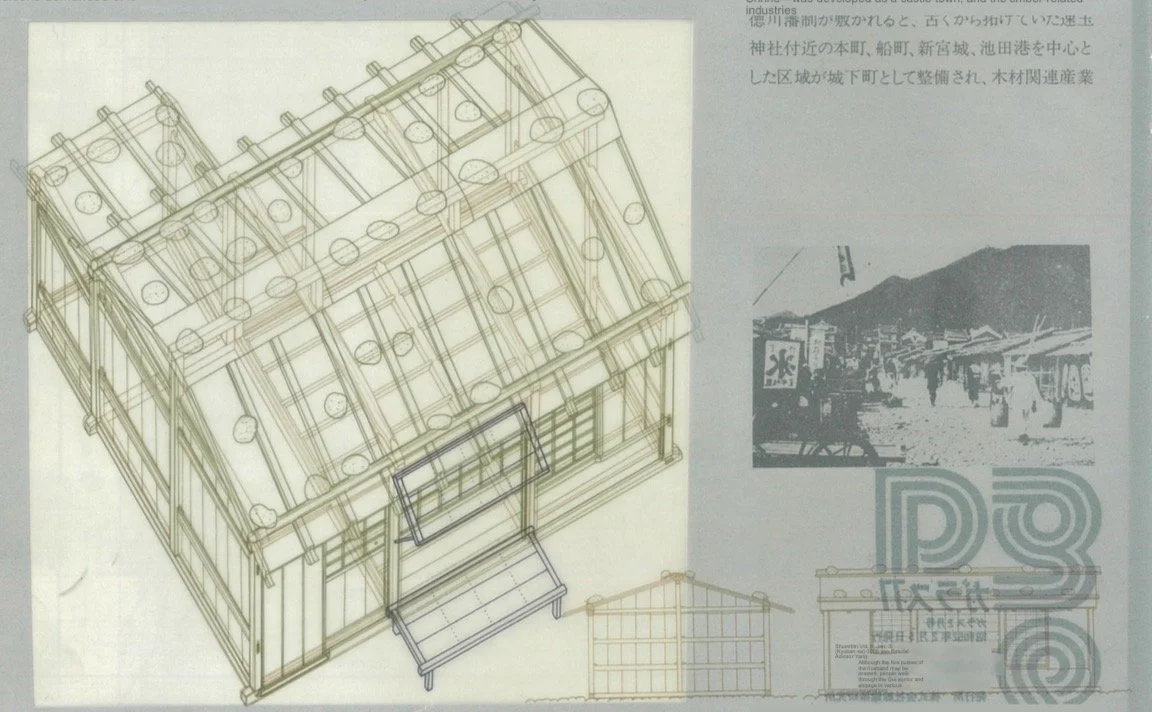
Image from Glass & Architecture Magazine, Issue 77, published February 5 1977